
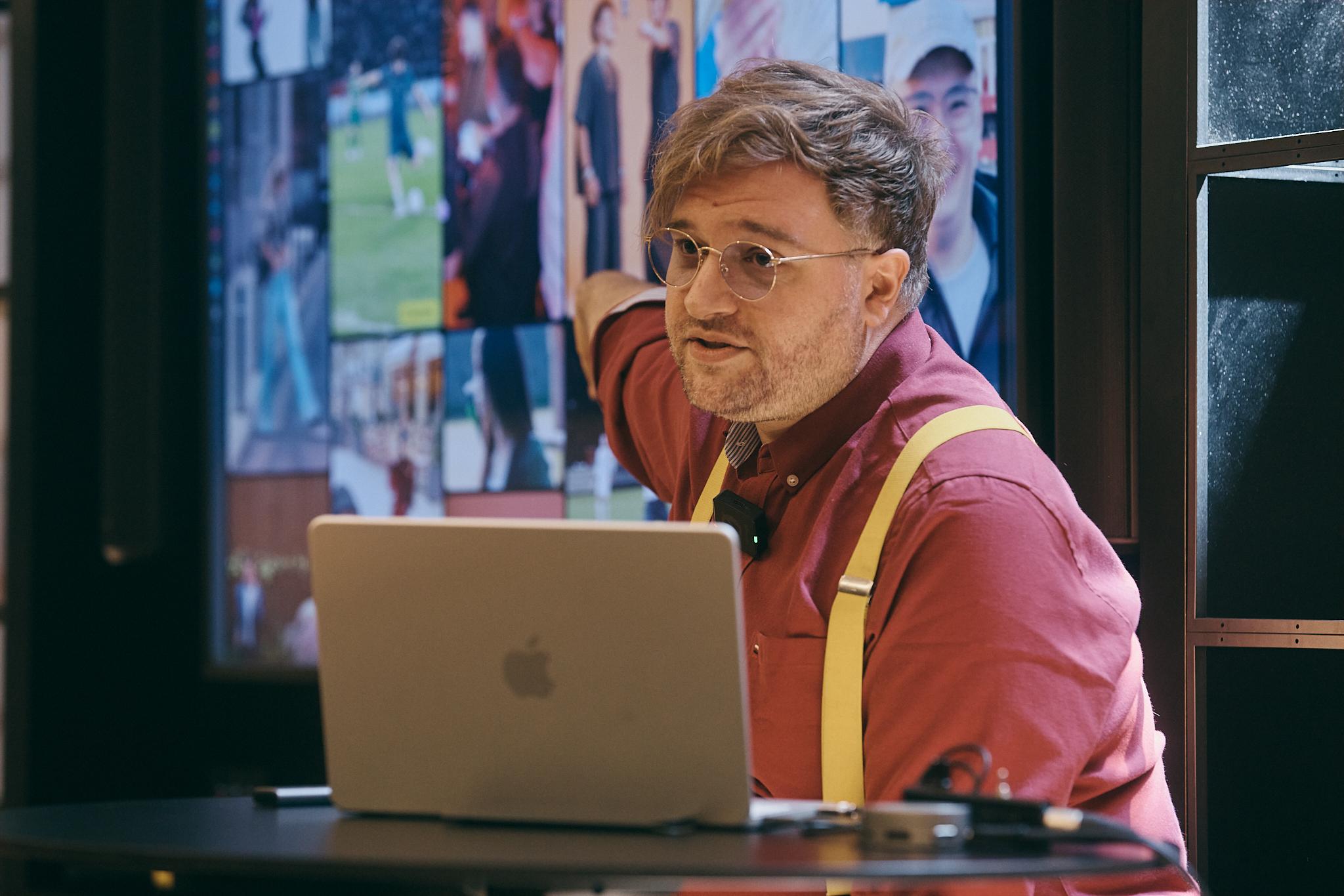
What can libraries do when someone walks up to the information desk asking whether an AI-generated image is real, or if a chatbot’s research advice can be trusted? In this Technologist Talk, Ramsay Reid Fellow Benjamin Kolaitis shares early findings from his research into how public libraries are responding to AI.
Ben unpacks what’s going on inside a chatbot – "a very, very fancy probability machine" – and shows how quickly AI-generated music, video and podcasts are reaching our feeds. With scams now fooling even confident, digitally literate people, the old tips no longer work. As other services retreat online, Ben argues libraries are becoming the only human layer of in-person information support left.
In conversation with Carmen Eastman, Manager, Library Sector Engagement, and in a lively Q&A, Ben explores staff training, conscientious objectors, epistemic literacy, local history and cultural protection, and what collections teams should expect from vendors.
Speakers & producers


Transcript
Ana Tiquia
Hi everyone. Thank you so much for joining us and for joining SLV’s Technologist Talks today. We're really lucky to have Benjamin Kolaitis come and join us as our key speaker. My name is Ana Tiquia I'm head of Innovation and Research at State Library Victoria. It's really, really wonderful to have been here. Ben Kolaitis is our current Ramsay Reid Library sector Fellow has been conducting a huge amount of research into libraries in their response to AI and AI governance, and Ben has a really impressive background and CV,
A long bio, I said I wouldn't read it all, but broadly, Ben has an incredible background working both across creative technology, setting up media labs, setting up makerspaces and public labs, not least across the City of Melbourne libraries. He also has a background in social work and academic research, and in Ben's current role, he's working at City of Melbourne Libraries as the programs and partnerships lead, where he supports teams to design and deliver community led programs that strengthen belonging, literacy and civic participation.
He's a strong advocate for public libraries as an essential civic infrastructure for digital inclusion, equitable access to information, creative learning, and meaningful public engagement. So it's really exciting to have Ben here to talk about libraries as civic anchors in the age of AI, and I'm going to hand over to Ben so he can share his research, and then Carmen Eastman, who's manager of library sector engagement, is going to have a quick chat with Ben, and we'll open up the space for some Q&A as well.
Benjamin Kolaitis
Thank you. Ana, my background, like Ana said, is like very much in this creative technology space. I found myself working in libraries more from a literacy support point of view. So if any of you have been to any of the makerspaces in City of Melbourne library or so Library at the Dock, Narrm Ngarrgu or Kathleen Syme, they’re my babies, I worked real hard on those guys, and the teams that operate them worked really hard to pull together a space where you've got essentially a creative technologist / art therapist with a librarian focus.
So those two sort of spaces came together in those PDs. If you haven't seen those spaces, highly recommend checking them out. They’re pretty cool. And they're pretty fun and they're all free, and you'll get to see some of the daily work that teams do, particularly around the literacy and people who are homeless. Learning these quite advanced skills, as well as people who are really struggling with digital literacy.
So that's just that little sort of spiel for them. So what am I doing?
Is what I'm doing scary or not? Probably slightly scary, but it's... I want to be clear, a lot of this research or the focus around it is just going, hey, what's the deal? Where are we at? What's going on? What matters to us? What doesn't matter to us? There is a huge amount of research being thrown about everywhere from all of the industries, very much academic library industry as well, not so much the public library industry that they're still developing it.
But I'd say the most advanced research I'm reading at the moment is within the computer science space, and very much the academic library space as well. So want to sort of make that sort of clear. But in all of that, I'm also interviewing a whole bunch of experts who've worked in the industry who are working on AI, who are working with misinformation and those sorts of things, too.
So this is just me giving you a little bit of a brief overview of from talking to all of those people. What should we care about? What should we be scared of? All of those sorts of things there. But before I go into it, I do want to just sort of hone in on what the hell is actually happening.
Right? So you've got a little chatbot, you put some words in, it comes back with some fancy stuff. It can come back with things that feel like it's reasoned, so it can come back with things that feel like it's considered, but it's not. It's just a very, very, very fancy probability machine. Some of the things I think is really important to note.
So this is very simplistic version, but this gives you a little bit of a rough idea of, from an information perspective, what it actually sort of looks like [Ben shows a diagram of an how a prompt becomes the next token .]So in that very, very bottom tray down there, that's that training data. So it's all of this data that it's been trained through. And in that data, imagine it like in your library, you've got all your library catalog records.
Right. And then what they call as them dimensions are essentially all the different characteristics of the book that are there. So it'll go through the colour of the book, the size of the book. What are the topics that relates to what are the common sort of like where was it published? Who wrote it, what's the characteristics of who wrote it?
So in a computer science base they sort essentially called them different dimensions. But in a library category sort of point of view, you'd almost call them like the metadata elements of it. So when you put your little prompt in, so let's say cat sat on the mat, it'll break up each of those little words there. It'll tokenize them.
So it’ll find little bits of data and memory to put it and glue it to. And then once it goes through the training data, it's basically called a vector space. So imagine it all looking at all of the relationships together and trying to find almost, I guess you'd call it positional data to relate to each other in terms of associations.
Then from there, every single association starts coming up, bubbling up from the top, and then there's a whole bunch of really fancy math and really, really fancy processes that go to to start filtering out of all of those word associations, what matters, what's relevant, what's the next word in the sentence sort of setting. So each of those attention layers, I want you to think of these things almost like a heat map.
So, when I've got the word cat and I've got the word sat next to each other, what are the most common words that are most likely to pop up when those two words sit side by side and then essentially creates like a big heat map in front of you, an inference map, which is what I call it.
And you've got almost this sort of like overarching theme of like, okay, when those two are there, mat, that's pretty strong in that spot. And then it will jumble up all of the tokens layer by layer, and then look at every single probability of all the relationships that sit there. Then if you sort of think about it more in a physical space, all it does is in the end is it looks down through all of these windows of heat maps and then finds the hottest points that are there, and then that helps it figure out what's the next word to come up.
The problem where it gets a little bit tough is sometimes those words are the hottest. So the top are literally 0.00000 of a difference to each other. So it will literally just throw randomness to make that selection a lot of the time as well. So keep that in mind. What you're getting is a really, really, really complex, sophisticated prediction machine, not a reasoning machine.
The reasoning that goes in there is about the associations that are there, but not necessarily the processes that are going on. There's some folk working on how to bring that process driven reasoning there. Not quite yet, but I wanted to talk about that because it's one thing a lot of these talks I go to, no one's actually talking about, hey, what's actually going on?
I think thinking about it as a probability machine and a really fancy relevancy probability machine is really important. So what. can it do?
A lot of us have seen all of these different things, but I wanted to show you some of them in action so it can make documents. AI was trained on chess. All of it was trained on chess. But really, really, really good knowledge is embedded in a lot of the training data around chess. So I went, okay, let's see if it can just vibe code me and make me a reference document for chess.
So this is not me touching any bit in here [Ben shows a document that serves as a reference guide for Chess .] This is all code AI generated, works out fancy chess trees, finds me all of the openers and then created me a 100-page reference book on all the openers for chess. So I think this is really important to show. Like this is the type of level it can do. If you know what the data is, and it's easy to verify, it can pump you out huge data sets of information.
So think about it in terms of what does that mean for Wikipedia stuff, encyclopedias, reference material. That's a really important thing to think about for good and for bad. It still needs to be verified and checked. The other thing that's worth noting too is it's big change to software. So if any of you have friends working in the software industry at the moment, it has vastly changed.
Vastly, vastly, vastly changed. Most folks I know have gone down from, say, teams of 15 to 20, with contractors overseas also doing some code for them to everything being in-house, half the team and everyone's just got different agents that they're running stuff through. So this is probably the best one. Shopify was doing it a long, long time ago, but this gives you a good example of where this is sort of going and where it's likely going to land.
Farhan Thawar, Head of Engineering, Shopify
[Video plays : "I believe we were the first company outside of GitHub to use GitHub Copilot. And the reason I know that is because when Thomas Dohmke became the CEO of GitHub the same day, I emailed him saying I would like GitHub copilot, this is 2021, a year before ChatGPT, he messaged me back saying it's not available for commercial use and I said, that's not what I asked.
I don't care what you have for commercial use. I would like this deployed for all Shopify engineers as soon as humanly possible. I think it took him about a month, and we were not charged for two years because there was not a SKU charge. And we said in exchange, we'll give you lots and lots of feedback. And so we were using copilot for a long time, and then we worked with them as we started looking at the roadmap.
We then deploy Cursor internally as well. Actually we're all very new to Cursor about a year. It's a Cursor. So we've kind of trying all these things and as we try them we want to see what's working, what's not working. And then we let more engineers use this. The most interesting thing about Cursor is that the growth in Cursor at Shopify is happening a lot outside of engineering and R&D, finance, sales support.
Those are the teams using Cursor". Video ends]
Benjamin Kolaitis
So I think that's a really important thing to note is like the commercial industry in software engineering has jumped the gun. They're ready to roll. All the startups are doing it. And it isn't just software stuff. It's everything across the board. So that things it's really worth noting. And as a quick sort of example, like what does it look like to vibe code something.
This is just something that I built probably in about, I don't know, maybe like half an hour, an hour or so, just vibe coding alone. [Ben shows a Winamp-like skin and player he vibe coded ] It's just a four chord. We'll see if it goes through just a four chord little sampler sort of setting, and you can add little keys and stuff to it in there. And then it's also got a Winamp style old school 90s sort of like visualizer.
Note that stuff like that for a creative person and making instruments and those sorts of things, that's a new world for them. Yeah, a totally new world. This in the old days I could code this myself. It would take me probably about a week or two to code that. Within the hour. That's a whole other journey. That's a new that's a new world of like what we can do.
So then I don't know if anyone seen this recently, but Suno which is the new AI music making app has just released a new model. It is very next level. You can give it proper music direction like a music production person and it will to a tee follow through. So here's just a little example of it.
Suno
[Music plays: "Every word becomes a number. Every number finds its place. A thousand hidden pathways, the machine begins to trace attention with fragments, predicts the next flight. It sounds like it..."]
Benjamin Kolaitis
For pop music. That's scary. Yeah. Next time you're listening to Spotify, I think maybe have a double take because some of that stuff is filtering into those spaces. So you notice how now, like we're seeing some of these things and now we're going like, oh, wait a minute. When I saw that thing, was that
What I meant to see was that, was that human or not human? I don't know. And then last but not least is Higgsfield. Higgsfield has taken the entire social media world by storm. These people are pretty much generating close to at the moment, maybe 25% of your reels. Very soon, probably 90% of your reels, you will have to double take with a lot of these things.
It is very real looking and everybody's jumping on it. Also, the thing that's scary is, is people are automating this. So there are folks who will have an automation chain where they'll go, hey bot, go off and see what's the top trends and top hits for the day are. I want you to generate me three images start, middle and end.
And then it'll automatically run it through these and then automatically upload. So the things just churning in the background and then they just throwing money at it basically. So that is the stuff that I think is really worth noting. And then last but not least.
Is also this new world of automated agents, essentially. I'll play this little script for you here.
Sundar Pinchai, CEO, Google
[Video plays ] "It's an agent that can interact with the web and get stuff done. I'll give you access to my Gmail and my Google Calendar."
News reporter
[Video continues] "Today's big AI companies want to change the way you use the internet. Let a virtual personal assistant run your online life. You've reached the beginning of the end of humans being the primary users of the internet." [Video ends]
Benjamin Kolaitis
That. Did you hear that? That's real. That's already happened. Last June, there's more bots on the internet than humans. Straight up. So what does that mean? Well, everyone's going to have to start installing Cloudflare now on all your websites. It actually happened to us over at City of Melbourne, where the amount of web scraping bots that came through our catalog was huge, to a point where it actually shut it down and we had to install Cloudflare to stop that.
So this is happening across the entire web, everywhere. And we looked at and we got Cloudflare to have a look at it. All those bots came from America as well. So that's different. Understanding protection of data and those things is a whole new space for us too. So do you trust me? [Ben shows a slide with a paragraph on it containing em dashes ] Do you trust me if you read something like this, do you trust me based on what's there, or is there something that's changed in that semantics that's written in the words that make you go, oh, wait a minute.
I don't know if that was him or not. What about now? Do you still trust me, even though I've got, like, a weird compactor thing crushing humans in the corner there? [Ben shows a slide with an infographic on it ] Do you trust me? How about now? So I don't know if anyone's played with NotebookLM, but I fed it a whole bunch of data to create essentially a fake podcast for me.
Fake podcaster
[Audio plays: "You're adopting a technology way faster than we are learning how to live with it. So welcome to the deep Dive.
Glad to be here today.
We are taking a massive stack of research and really looking at how society is trying to bridge that trust gap.
And it is a phenomenal stack of data to sort through.
Today we're looking at the 2025 Global study..." Audio ends]
Benjamin Kolaitis
Sounds real I could just release that and you probably wouldn't know. Yeah. Or what about this?
Fake podcaster 2
[Audio plays: "The sustained basic messaging, but it often fails to support data intensive tasks like daily remote work, critical telehealth appointments, or modern educational portals. This infrastructure decay maps directly onto geography as the distance from metropolitan hub." Audio ends]
Benjamin Kolaitis
Same deal didn't touch it, just a prompt. That was all. So what does that mean now around trust? What we knew that we could go and find information. We could trust that information, or at least we could verify against other things. We might be able to go, hey, at least at some point, some human touched this for us to go.
Is it real or is it not? We could question the intentions of the writer, the author, but the amount of it that was getting generated and created was much, much smaller. We're talking about an avalanche of information that's going to be being thrown at us and is being thrown at us at the moment. So there's been some really great research.
Commonwealth Bank actually did a really good one around how confident people are at spotting scams, which I thought was really interesting. 89% of people were confident they spotted a scam, but out of those 89, 42% were actually only accurate. So we're still looking at like less than a coin flip of people who feel confident to think they are spotting a scam, to actually only being about 50% right or wrong.
That's worrying, that's digitally literate people not knowing the difference. That's a different situation. The other one to is, a lot of folks, there's been some really, really good research, around like trust and building around that. The main bit there is, is a lot of these, think tanks are showing that most folks are worried, most folks are scared, and most people can't verify this stuff either.
So for us in this digital literacy sort of space in the library area, all of us are very much aware of scams. It's been a bread and butter thing for a while for us. How do I spot a scam? The old school way of doing it was I'll look for the email address. They might be a weird thing there.
Or hey, look for a typo. There might be something wrong there. That's out. That's done. Gone. I wouldn't even bother keeping that stuff in your curriculum anymore if you're doing it. So we do, as an industry, we need to rethink all of this stuff. But I'll play this really quick.
News reporter
[Audio plays ] "Intelligence is seemingly
everywhere and is increasingly being used to create sophisticated scams that are even leaving experts second guessing. 2025 report from the National Anti-Scam Centre found Australians lost $945 million to investment scans last year. That's accounting for almost half of the total $2 billion fleeced by scammers." [Audio ends]
Benjamin Kolaitis
That's a lot of money. That's a lot of money, folks.
So what's happening now? So there are good folk working on it. Don't worry, it isn't all doom and gloom. I've been hanging out quite a bit with MAV, with eSafety, meeting some federal folk around it. I also got to meet Beth Noveck who did a bunch of work around digital literacy and stuff, and also innovation transformation for the Obama administration and Angela Merkel and all these folks.
Everybody is running to figure out what the hell is regulation around all of this stuff. But the key bit behind it is, what does it mean if there's a bad actor? And this is the bit where I think we have a role, and I think it's something that we all need to start talking about. So the Public Libraries survey plan is one that happens pretty like regularly.
We know people feel safe and welcome in our spaces. We know that there is a natural sense of trust that people have in our spaces. And with librarians. People know that we are doing our best to change and be relevant to them in terms of our collections, in terms of our programs and the things that we do to connect with people.
People agree with that, which is great. At the same time, a lot of staff and a lot of staff surveys are showing that they understand that media literacy is a part of their job, but not many of them are actually super confident in it. But now we're in a bit of a position where that has to start changing.
Media literacy is going to matter from an information professional point of view. If people are coming to your customer service desk like us, people are coming to you going, hey, I want to understand about this thing, or I saw this thing online, or I got this Instagram post telling me I should look at this thing, or hey, I heard that this thing was happening.
Is this true or not? Recently I did a, a staff training day over for the Connected libraries for CEO Beth Luppino and, we asked all of the staff in the room like, hey, what's happening in terms of stuff that's happening for you in those areas? We had people say, oh, there have been people who were saying, oh, I've been told that, I've got a health problem from this AI, and I'm trying to research it or not.
But then when they actually looked at the information I was providing, all of it was fake. None of it was real. There is a role there for us. The other part there that I think is really important to know is that people look to us as an in-person information support layer. On a civic level. This isn't just, oh, they could go to the internet, or they could go here or there.
We are literally the only human layer for information support that is around. And if you take into account the fact that other industries are going to reduce their in-person customer service and their online real human customer service and over the phone customer service, people needing to find information is going to become a really, really, really important role from a civic point of view.
So we're talking misinformation support on a civic layer like, hey, if someone's getting fed all of this stuff, that's not true. Where do you go? Is there a place I can walk into? Oh, you know my grandpa, Steve, you know, he got scammed the other day. He just can't deal with the stuff on over the phone or online.
And they just tell him to click these things. Is there somewhere I can send him? Public libraries are that spot for people to. So I think that's really important to keep in mind. So, a lot of folk, a big part of the regulation or the data that's sitting behind it is, is everybody agrees we want to figure out how to deal with misinformation around AI.
We know in our spaces that our Wi-Fi and public computers are being used. I think the question also comes is if people are using those services in our spaces, what level of responsibility do we have on safe use of those things as well? That stuff will pop up. In our situation over at City of Melbourne, we've had situations where people have thought they're having a health crisis from use of AI.
There's a lot of homeless folk that will sit and they don't have anyone to talk to. They're feeling very, very lonely. They're there with the chatbot, someone to talk to. It's responding to them. There's been cases where people will have mental health crises around it, not necessarily because of the AI, but it is a part of the picture now.
People having health crisis and mental health crisis around AI is a thing. We are a public place. I'm sure many of you that work in the library see these things happen on a daily basis. That's now part of the picture too. So we have to consider those things.
So look, this is early days in terms of where I'm getting at with a lot of the research. The plan is I'm going to be releasing these interviews and I'm going to be having them supported with A4 like essentially sort of like roadmaps on areas that leadership and staff need to think about in terms of training and direction or areas that need to be looked at.
But this is a little bit of an early draft of where I'm at. We are information support professionals. That is our job. We're trained for it, whether you like it or not. That is what we do on a daily basis. We need to own that and we need to own the new information landscape right now because it is vastly changed.
I think it's important to take that on board. The other bit is, like I said before, the retreat of customer service. That is a big thing. We have to make sure that that human layer is sanctified within our spaces because it's needed on a civic level, access of inclusion of course, spaces, technology, of course we do those things. The other element of it, too, that is something that we need to think about in industry is what are our vendors doing?
I met up with Steve Potash, who's CEO for Overdrive recently, from his point of view and everyone else that's talking about it mostly in American context, all of them are open to including AI generated creative works on their platforms. That is something that they're looking at from their point of view. They would just be like, just add a filter.
People, customers, consumers get to choose what they want to use. If it's there, they don't want to see it or do want to see it, who cares? We'll just pop it there and see what happens, right? The thing to take into account that too, is, is okay. If you're in a library and you've got people who've got their books on that platform, how are they going to feel about being side by side with AI generated stuff?
What does that mean? Also, what does it mean for your consumers moving to AI generated content? How do we feel about that? How do we want to talk about it? How do we want to think about it? That's an important conversation for us all to have. Records and Accountability. Look, the whole cybersecurity thing has changed. Like I said before, if you do have anything online right now, consider Cloudflare.
You just need to have it now. The web scraping bots are coming out everywhere, and if you've got content like us that's there, that's open and public, it will get scraped, guaranteed. Governance and policy, of course, that is the big can of worms that no one can figure out but we will eventually get there. But by the time we get there, this other stuff has to happen with us first.
We can't rely on the governance and the policy bits to do that bit for us. We've got to work out what we want to do first, and then that will actually feed into the governance and policy as it goes forward. ALIA is doing some good stuff around it. Carmen and I will talk a little bit about some of that stuff that's happening in the background.
And also MAV, from a procurement point of view, is also doing a whole bunch of work around how do you deal with suppliers that are using AI? What do you do with it regarding like privacy and information? What if your LMS system wants to integrate it? What bits can they and can't be integrated into? All of that stuff is being worked out by, from a procurement layer, the Municipal Association of Victoria, so they'll figure out who can and can't be on certain tender panels and who you can work with and those sorts of things.
Then the other bit is, is what do we have to figure out? Look, my key areas that I think is, is like staff consultation is going to be a big discussion around this. The union is very much interested in figuring this bit out too. I do think that there's going to probably be an element of people or organisations creating essentially an organisational framework for the use of their AI and their own in their own business or company or organisation.
So it could be a sort of thing where it will be like, hey, when we're using AI, these are the things we will use it for. These are the things we won't use it for. If we are using it in these settings where there's human layers, what are the protection mechanisms here? And also what are the accountabilities level here.
And there'll be other elements of it to where in some ways we might even have to write a code of conduct for AI in some way around how it does work in our spaces, and how do we talk to it if it's implemented in our spaces? ICIP and local history is a big, big can of worms.
What do we do around First Nations information protection, cultural protection. It's getting scraped. It's already happened. But we've got to figure out, you know, how do we deal with that as a cultural institution? You know, how do we make sure that we can have those protections in place? Local history is very interesting from public library point of view, because of course, there's some of that element that's democracy information.
People will upload their own images. You know, there's a lot of background there where there is industry that cares about local history stuff because they want to know what's got a heritage overlay or not. So there is actually some bad actors who might want to show that something does or doesn't have a heritage background. As a bad actor, you could potentially just create a whole bunch of fake history, you know, and then it's up to librarians to sift through it.
If they're going to be giving out advice and helping people manage and look through their collections as well. And then the partnerships element of it, too, is, is who are the folks that we should work with to help us navigate it? So I think, one of the key things to note is Good Things Foundation is doing really, really, really good work at the moment.
So if anyone wants to look at resources, Good Things Foundation is your go to, they have got money from everybody to essentially try and create as many literacy documents as possible. Looking at them all, I think they're all pretty robust, at least from a staff training point of view. Or if you want to run literacy workshops for folk yourself.
Then the other key areas are as like all the state libraries are working on something on to some capacity, so it's still the TBC element there. State Library of South Australia is doing a lot of great work in that space at the moment. The other areas is there's a really great group called the ARC Centre of Excellence for Automated Decision-Making and Society (ADM+S).
They're Australia wide. They're doing a lot of this work to essentially try and provide information to both federal and state governments around how to navigate the regulatory frameworks that are there. Anyway, that's my spin on that. In terms of what’s sort of coming or where we're looking at things at the moment, this is a bit of a rough timeline of what to expect over the next sort of year or so.
In terms of, state government, there's a lot of stuff that's being fueled into what can, you know, government employees, both local and state and federal, can and can't do when using AI. There's a lot of information coming out from them around that. The national cabinet is also looking at, you know, implementing a lot of stuff around AI regulation, which is just industry and also us.
The thing that I think is important to note is, is, a lot of the discussions I've come across from folk in these areas is most of the focus is the education industry and the vocational industry. And also just like essentially industry, industry, there is an area there where they're still not sure how to look at the literacy lens or the civic support lens out of it.
That's where Good Things Foundation and libraries are starting to come to a rallying cry around it. And it's starting to happen in Australia wide and overseas as well. So that is something that's sort of cool in our area, and I think it's worth watching and looking for as well.
And. Look, I'm not going to go through this, but it'll be in what my report is. But if there's anything that you wish I think we should focus on is, is really looking at some of the background of what librarian training does, which is around understanding epistemic. What is epistemics? It’s essentially just the theory and the knowledge and the philosophy of knowledge, the philosophy of knowledge, essentially.
But the rigor of how that's understood, this is going to help us navigate this information lens. This is how we're going to understand provenance. So how we're going to understand trust. You know, whenever we get something understanding where the information gaps, understanding whether or not there's good confidence behind where those came from, where did it come from? Did someone else verify that it's real or not?
Where are we in that as a, you know, do I use my judgment to determine whether or not this is real or wrong? And then also what's the outcome of whatever this produces or whatever the AI produces? Is there community authorship there? Is there a part where communities can go, no, that's our cultural information. Don't use that or you can or you can't use that.
I think there's going to be a lot of industry discussion around this, and I think they'll try and figure out ways to embed this sort of stuff in ethical AI. And I do think that there's probably a place for us in this. That's just what I'm seeing in the moment. But that's pretty much where I'm sort of learning with them.
Anyway. I've spoken a lot. If you want to follow along with how we're going, I'm slowly building this LinkedIn discussion group. So all the different people are a QR code away. Yeah, but thank you, everyone.
Carmen Eastman
Thank you so much, Ben. First, I just want to say thank you for the work you've been doing in this space. The library sector team has really been enjoying following Ben on the journey into AI and public libraries. We've learned a lot. We've had lots of robust discussions. It’s been a pretty wild ride. I think I'll start with one question and then I'll open it up to the rest of the group, if that's okay.
So one of the things that I deal with in the library sector team is how the library sector is tackling AI as an issue. We've got things coming through from ALIA, things from PLV, IFLA, but we don't all seem to be on the same page. I was just wondering if you had a sense of how we're coordinating as a sector, or what we could do to better coordinate as a sector?
Benjamin Kolaitis
Oh Lord, I think it's like just from my experience, managing any of that stuff is sort of like managing chaos at the end of the day, really. Everyone is of course going to be doing their own thing. Everyone's a little bit siloed. I think the main thing is, is I think those that are on a leadership level, I think having a collaborative mindset around it is really important, and being able to let everyone know about what's going on within the leadership space, I think is fundamental right now.
Because there's just everyone's running in every different direction. You've got academic libraries hunting essentially for what is the perfect AI research assistant. That's sort of the holy grail at the moment from a lot of folk I've met in the academic library space. They're running for it there. That epistemic literacy stuff is a bit of a backbone behind what they're trying to figure out in that space.
They want to train AI to know that epistemic literacy process and have a human librarian layer part of it together. I can actually show you very quickly.
Keenious. So I met this fellow in... I went to IFLA in South Korea and met this fellow. So he's actually got a librarian version [of Kennious]. You can actually have this as an API that embeds itself, in your catalog if you wanted to. But he has a very different approach for it. So this is a tangent, but I will get back to the answer for it.
So how do you navigate the public library sector to understand coordinating AI? Okay, so this is a little bit different to what you would see in a normal ChatGPT situation. So interestingly enough... so the backbone behind this is he's on a very small layer. He's actually using Google and Flash or Gemini Flash. Sorry. And he's using that as essentially just the backbone sort of search engine type sort of thing.
So notice how this is really different to say a ChatGPT. So ChatGPT will tend to sort of break things down, summarize everything for you sort of stuff like that. If you look at this, the way it structured is, it's actually very basic and it's more directional. So it's not really trying to do lots of summarization. It's just going, hey, these are the subject areas.
Consider these for your research. Right. The thing that's really cool that I love that he did, is that he figured out to how you can, you know, that sort of embedded training space I showed you before and then figuring out the relationships based on their positions. That's it here. So he can actually... so let's say you've got your catalog now let's say... Down here.
So you can actually sort of get an idea of roughly semantically an information lens landscape, how correlated things are from a positional point of view. That's sort of new. And notice here that this isn't necessarily summarizing and changing things. This is actually just a guide. And the idea is some of these academic libraries are using this tool to support librarians because it's still... a librarian needs to help with going, okay, let me work out what are the right subject headings for you.
This might relate to different parts of my catalog. Okay. Well I want to know about regional AI readiness. Okay. Well we'll look closer to that okay. Here's here's a journal article that's there. If I want to look at something that's a little bit more closely related. So you can see how it's sort of doing more of like a landscape of understanding or catalog, rather than just an answer machine type sort of thing. That's different.
So in terms of like why this stuff matters, like I think going to conference is going to talks like this. All of us talking about it really matters. And my hope is that a lot of it will just filter to the key institutions, essentially. I think the challenge that we were talking about this before, too, I think the challenge at the moment is, is where do we all sing strong about?
And I think that's something that I want to try and showcase a bit in this research. I do think there are key areas around information, landscape, stuff that I think needs to be talked about. Staff training is number one priority for everyone. I don't doesn't matter what fancy tools you want to implement or anything, if you don't have an educated staff cohort that can also think about it critically and come to the table to know, hey, let's have a commonality and an understanding of what that means.
All of the other stuff that the institutions are doing won't matter. They'll write a thing, they'll put it to an institution, and then the staff will be like, well, I don't know what that means or what's that for? Doesn't matter. So I do think the literacy angle that we're doing with the PLV stuff, with the one that SLV is running, I think that's the starting point for everybody.
I don't think anything else should jump the gun yet, but I think that yeah.
Carmen Eastman
Thank you. Okay. So I'm going to open up to everybody else who's got a question for Ben.
Guest
I suppose I'm curious. You've touched on verification a lot, and I think, you know, I guess your thoughts on what are the steps to take there. You know, if we are that in-person information support that you mentioned as libraries, what is, at this current point in time, the guidance we can give on people and verifying the outputs they're getting from AI.
Benjamin Kolaitis
I think that's that comes down to as an industry, we've got to figure it out. I think as a librarian, if you work as a librarian, I think you know.
A lot of that knowledge already. But you also need to understand a little bit about, okay, how is misinformation getting created at the moment? What are my bits that I need to look out for? I don't think I don't think anyone has an answer to that question yet. But I would say out of all the industries, it seems like the library industry is the most obvious industry to help work that out, at least in terms of a navigation and collection point of view.
Look, I've been meeting with some folks with like Telstra and, eSafety Commission and things like that. Most of their discussions around what is true or what is real in some regards, all of them only really care about the misinformation scam space and the way they're approaching it is very, very, very different to us. So say for example, Telstra and the telecommunication industry.
I don't know if any of you know this. You might even find this will happen to you, but you might get a text out of nowhere that goes, we think you've been talking to someone dodgy. Has anyone had that yet? That's what they're starting to roll out. So because I'm been testing these tools, like getting things pop up for me and going like, hey, we've noticed some like things on, on our network that seem a little bit like, we want to just warn you to think twice about your engagements.
All of them are doing that on an algorithmic level. So they've I think the law passed recently. I've got a double check. But they are they call it ‘soft sniffing’ on the line. So what they do is, is they have very basic rudimentary algorithmic scales to look at. Hey, if there is certain like communications or things happening that are coming from a certain part of the country or a certain IP or certain things that are popping up, then there is an automation lens, so no human touches where it automatically texts you or sends you, I think.
No, just text. It'll text you and say, hey, we've noticed this activity. It's looking like banks might move down the same angle a little bit more, except it'll come up in the bank app as well. So the computer science world is more interested in that bit there, and we'll get some cool tools to be like, hey, can I run it through this thing?
And it will tell me if that's a real video or a fake video or a real text or not text. That stuff will come up soon for us that we can use. But that bit around like, hey, how do I navigate the information landscape? How do I even think about research at the moment? You know, if I'm researching stuff and I don't know if it's real or was it written?
How do I know that's a real journal or not? I honestly think that that's us.
Carmen Eastman
Ben, I might just jump in and say there is a lot of people in the industry that think that's us and that's our role. But I work with a lot of library staff that are also conscientious objectors to AI. They don't want to use it and they actively will say, I'm not using it. There's a big gap there between those two points of view.
How would you navigate that as a manager? For example.
Benjamin Kolaitis
I have been I've got staff that are very, very not happy with it. And even if I'm talking about critical, you know, understanding or research things around it, you know, for some folk that can feel really, really scary and there's staff that, you know, I've managed who do find that, you know, threatening. It's scary. This stuff is scary.
Like I've shown you stuff there that’s like a whole bunch of stuff where all these people's jobs are just like gone, you know, and also all of those ethical challenges are there, the environmental challenges we all know about, you know, I don’t know if anyone's living in Footscray right now, you're not having a fun time right now.
You know, I know a whole bunch of folks that are just going out and measuring the air pollution and the noise, stuff like that. Stuff is really, really, really, really tough. I think the problem stems from the rhetoric that's coming around AI being the solution to everything is the wrong rhetoric. And I think a lot of folks that I've spoken to on a staff level about this stuff is the anger.
And the fear is very much directed at that rhetoric. You know, there is a lot of people coming with wrong promises. I don't think that's the right. No one should believe Elon Musk. A lot of that stuff is just smoke and mirrors. There's a lot of smoke and mirrors in Silicon Valley. And, but I do think, look, when we actually start talking about some of the things I have showed you.
So it's like, hey, I'm not here telling you you should use these tools, but I am saying, this stuff is happening whether you're engaged or not and whether you like it or not, it's going to come to you. At some point, someone's going to come to your staff desk and say, hey, yea, nay, is this right? Is this wrong?
Is this real? Is it not? That is the bit where preparing for and that's the bit where I think we all have to have a conversation around. I think that's a really, really different way of being able to talk about it in a sense of making sure that like, look, I honestly believe that all of us will eventually get to a point where we will need to use some tools to help us navigate the problems the tools have made.
I think the information avalanche thing is literally just the tip of the iceberg right now. Like I said before, there's so much web scraping going on right now that web scraping is happening because everyone else is running to try and make their own models. And they want to try and make dumber models that are cheaper to run because those big, big, really good models are expensive to run.
So we're going to get an influx of all of these suppliers coming to us with their mini trained models that offer you quick answers that are just actually going to probably spout out a bunch of non-real stuff that's on its way. Heaps and heaps of people are working on that thing because it's a money making thing. They're like, oh, great, this business just wants a quick automation.
Outcome. Okay, I'll build a really simple model of my own LLM and then what I'm going to do is, is it will help that business just do simple stuff like gather all the invoice information, chuck it into a spreadsheet for them, and then put it into, you know, a Xero type sort of tax system. You know, that's the sorts of things that were happening in in the old days.
Well, now you call them old days, but even a year or two ago, that's how the IT software world worked. You know, there were just lots of tiny companies that made this one specific software that would do one thing really well, and then they would just run off that for ages. Now, what's going to happen is there's going to be influx of everyone, DIY that and just stuff everywhere.
So I guess the main bit around that is for us know, like whether we like it or not, it's coming our way. I think that the conversation that's the great starting conversation is the literacy bit, because if the staff members are encouraged to be like, right, you're angry about this, great, let's research it. Let's research the hell out of this thing and get to a point where we can talk about it critically with each other.
I think everyone will meet together with where the facts and the evidence are taking them. I do think there'll be fear there, but I think I'd rather walk towards my fear informed than uninformed.
Kieran Hegarty
My name’s Kieran Hegarty. I used to work on the Australian Digital Inclusion Index and in the Digital Inclusion Index we often talk about, kind of a spectrum of from highly excluded to highly included. And we think of excluded populations as having certain characteristics around age, location and so on, which feeds into how libraries design their services. They might support digital inclusion efforts around older populations.
For example, I was struck by your example around the ability of people to spot AI generated scams and that, so I'm just thinking, how will what you're talking about change that kind of skills that need to be taught and who they need to be taught to?
Benjamin Kolaitis
That's a great question, and thank you for working on that. Like anyone hasn't seen the Australian Digital Inclusion Index. It's holy grail. So good. We use it all the time to help us with planning with our stuff. It is a foundational, amazing resource that everyone has to read. And I think, honestly, the work that we're doing will interface more with that work.
So Anthony McCosker, who I've been working a bit with, worked on that, and he does run the Automated Decision Making and Society. Well, not runs, it but he's a big component of running that sort of group. The research group, he's I would say the way I think he's approaching it is probably the right way to do it.
So, he's been working with Good Things Foundation and there's at the moment, they're setting up trials of these things called AI hubs in neighborhood houses at the moment. And then his job is to essentially assess how those things go. So it's sort of like a drop in shop for anyone to ask questions about AI and what to do about it sort of thing.
I reckon the next step will likely be simple as an early point. Probably similar stuff like that popping up in libraries and neighborhood houses together. And from what he's described, it sounds like it also might be a place where a potential AI, you know, like survey could be done to also include itself in the ADII. That sounds like where it might go from talking to him.
I think I don't know whether or not it will or won't, but I think it makes sense for the ADII to move towards AI research and including that in the survey. I think some of the key bits there that I think will be interesting to look at is who is using it and what digital literacy skill set are the users?
You know, I think there's another element there to where, like I was saying before, there is a little bit of an unseen space, particularly in a lot of rough sleepers where rough sleepers are huge mobile phone data users. Massive. I don't know if anyone seen them in your spaces, in our spaces, like they've all got phones and they're all now spaces because I've got Wi-Fi so they can watch YouTube and all of these things.
You don’t have to ask them to leave a computer after an hour. They can sit there with an iPad. Or if I, I do think there's something in that space that will need some more looking into because particularly from the mental health side of things, I think that conversation will also change a little bit where I think AI will probably matter more in terms of density in urban and city environments versus regional like a lot of the ADII stuff, had a great piece around, hey, rural Australia is not in a good place and infrastructure wise has big, big, big problems there.
And there's a lot of money going with NBN and those folks to figure that out. ACCAN I can't remember their full names like the Australian Communications [Consumer Action Network] It's basically like the policy sort of like advocacy main group that looks at all of those things around telecommunication policy. Those folks are very much focused on how do we look at getting infrastructure, how can we look at making access to the internet cheaper?
That stuff, I think, will never go away. The ADII showed that really strongly, but I do think the challenges in an urban environment, particularly around misinformation and health incidences and things like that, I do think we'll see changes higher here because there's just a higher density and I think lower income and public housing and, you know, rough housing sort of situations, I think will start mattering more in that literacy space.
I don't know if I answered that, but I would say Anthony McCosker and the Automated Decision Making in Society group, I think they're going in that direction towards the ADIII, from what I can tell, they're going in that sort of direction.
Carmen Eastman
Thank you. Ben, we've hit time. If I have one last question, I think that would be great.
Amanda (audience member)
Hi. My name is Amanda. I work in collections and acquisitions with Brimbank Libraries, and I think what I'm really interested about is ensuring that the resources that we're providing our customers with, both in the print material and the online resources that we purchase, that we actually have that same level of understanding of provenance and verification, so that when people come to libraries, they need to know that they can pick up a book and know that it's correct.
And I think we can already see that there's items in our spaces that really probably shouldn't be there. And how we go about working together to, you know, better our relationships with our vendors put some rules in place and how we can sort of hold the line on that.
Benjamin Kolaitis
Yeah. All I can say is, is sounds like you're the right person in that job to help with that, because, look, I think there's a few challenges that I've come across the moment. So first and foremost there’s a procurement lens side of it. We need to have a robust policy on some degree, whether or not Municipal Association of Victoria sets one up or your institution or your local council has one.
There needs to be something there around. Okay. What does it mean for us to procure AI generated works of some kind or software or any of those things? I think that has to be there in the baseline, similar to, I don’t know if anyone in IT does procurement stuff, it's a pretty rough road around cloud checklists and, you know, like how many employees they have, are they involved in slavery?
Like there's a whole landscape there. I think that that makes sense just on a starting point to just sort of go, hey folks, if you were engaged in this stuff, play nice, you know? But then, of course, there's the other element of it is, is like a, I would say, us being literate, at least in the collection side of things across all the libraries, if we're all asking for the same thing, the suppliers will move towards our direction.
But I think we have to have a strong voice together around what we expect and what our expectations are as an industry, I do think PLV is in a great position to be able to help that call together, to be clear around that sort of stuff, I think we're slowly moving towards the rules, trying to figure it out still.
The biggest worry that I have is, well, I think what you'll see, or what I'm seeing at the moment is the online side of things, is likely going to get hit first. So e-books, e-comic books is probably going to get hit pretty hard first, I reckon as well. And then also e-learning as I saw another area that I think will get hit pretty tough.
I think there's a good chance, particularly because I know if anyone has LinkedIn Learning for their library, which we do. So LinkedIn learning is a really common platform for people to do digital literacy and learn creative schools skills and stuff like that. That's owned by Microsoft. Microsoft is very much owns, you know, Copilot and, you know, essentially there they run all the infrastructure that actually runs OpenAI models.
I think the likelihood of them starting to embed more AI videos. And, you know, like I showed you before, simple infographics and how to do things. I think LinkedIn learning will probably get hit first, and I think that's likely going to be there. Hopefully it's good information. Do we think it's right or wrong? I don't know yet. I think we have to talk about it to work that out.
I think it will come down to quality. And also, you know, the things around cultural protections and all of those sorts of things too. But then I think the bigger question around what happens when it hits print, that is the bit where I think traditionally from collections, people I've spoken to, we would just sort of rely on the publishers to do the right thing a little bit.
But that's not something that we can have trust for anymore. Yeah. Look, that's sort of been the way I've been trying to navigate and talking to folk about it and hearing what they're doing. At the end of the day, I would say it would come down to awesome collection librarians like you to go, wait a minute.
Let's think about this first and very much bringing PLV to the table, you know, and saying, hey, look, what's our quality as standard as, you know, a whole collections. I think the collections SIG (special interest group) that they've got their stuff like that, you know, what are we going to come together and go to all our suppliers and say, this is a quality test that we need, and this is a line in the sand.
And sure, like maybe 20 years in the future or ten years in the future, that it'll be a different line in the sand. We don't know. But I think that that's the starting point for all of us. And I think that's starting to happen as well.